

What Is The Makeup Of Russias Government
What Type Of Government Does Russian federation Have?
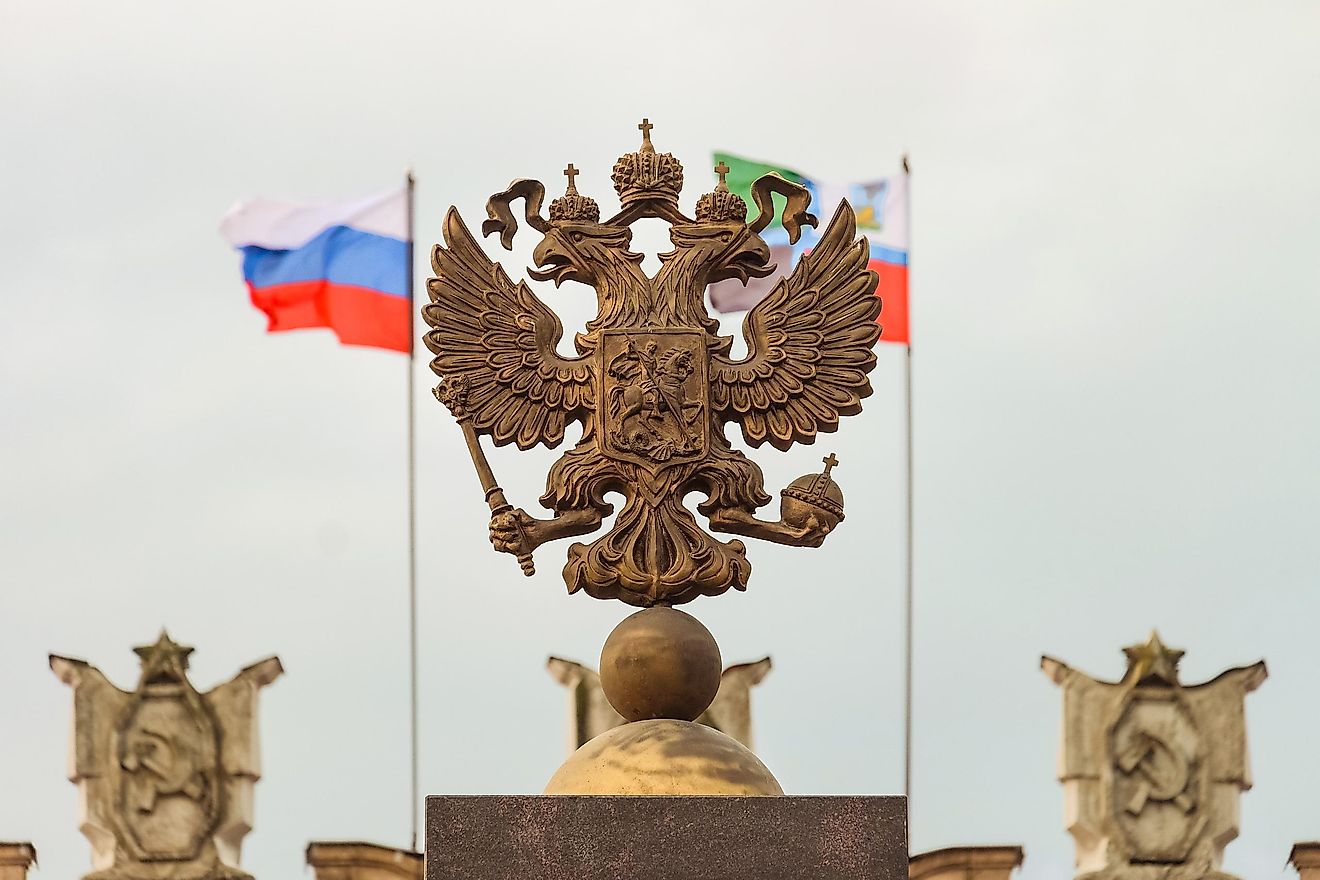
- In theory, Russia is a federal, democratic state.
- In practice, it is believed that virtually all power in Russia is in the easily of its president, Vladimir Putin.
- Putin has ruled Russia since the year 2000.
- Since Putin took ability in Russia, he has been accused of eroding human rights and democratic freedoms in the country.
On paper, Russia is a federal democratic land. In practice, however, many regard it equally a dictatorship congenital around one man, President Vladimir Putin, who has been the leader of the Russian Federation since the twelvemonth 2000. Russia has all the working parts of a autonomous state, but since Putin took power, experts believe these working parts have been fabricated to serve him and those close to him. Today, many believe that Putin now controls all levers of power in the land.
Post-Soviet Russia's Democratic Institutions
On Dec 25, 1991, the Soviet Spousal relationship ceased to be. The Russian Federation, formerly the Russian Soviet Federative Socialist Republic, was ane of 15 erstwhile Soviet republics to become independent. From this point onward, Russia began a chaotic transition from a communist dictatorship to a capitalist, multiparty democracy.
In 1993, a new constitution was ratified, formally making the land into a federal, democratic republic. This constitution supposedly protects people'southward fundamental human rights, such as freedom of expression and freedom of association. Article 10 of the constitution mentions the executive, legislative, and judicial branches that one would expect to find in any modern commonwealth, also equally the powers of those branches. Information technology also proclaims the independence of the iii branches.
The executive branch of Russian federation's government is headed by the President. The President of the Russian Federation is supposed to exist the ultimate guarantor of the fundamental rights and freedoms of the Russian people. He or she is responsible for maintaining the country's sovereignty, analogous the function and interaction of country bodies, determining the bones objectives of both foreign and domestic policy, and representing Russia on the international phase. The Russian President is besides the commander-in-principal of the state's armed forces. He or she is straight elected by Russia'south voters for a term of 6 years.
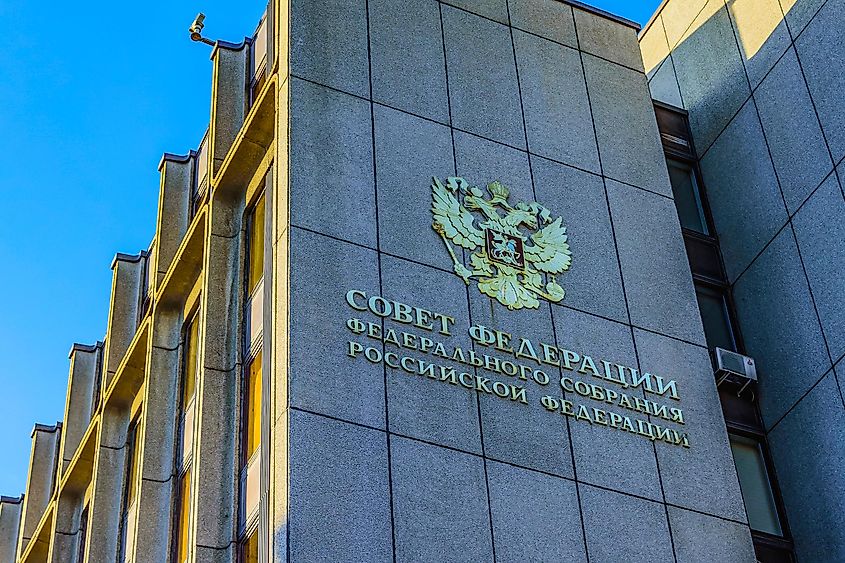
It is the job of the Russian President to appoint a Prime Minister, which must be approved past the Country Duma, the lower business firm of Russia's parliament, known as the Federal Assembly. The Prime Minister then appoints members of his or her chiffonier, who caput government ministries and departments, such as the Ministry of Defense and the Ministry of Foreign Diplomacy.
Article 94 of the Russian constitution puts legislative power in the easily of the Federal Assembly, which is a bicameral legislature composed of 2 houses. The lower house is the previously-mentioned Country Duma, and the upper house is called the Federation Quango. The State Duma is composed of 450 members, who are elected for terms of five years. The Federation Quango consists of two representatives from each elective entity of the Russian Federation. Ane representative represents the legislative branches of the constituent entities, and the other represents the executives of those entities. Also, the Russian President has the right to appoint his own representatives to the Federation Council, then long equally their numbers do not exceed 10% of all its members.
The Constitution of the Russia also establishes a judicial branch that is supposed to act independently of the executive and legislative branches of regime. The highest courts in Russia are the Ramble Court of the Russian federation and the Supreme Court of the Russian Federation. Judges of both the Ramble Court and the Supreme Court are appointed by the Federation Council based on a proposal by the Russian President. The Russian President also appoints the judges of the federal courts.
The Emergence Of Vladimir Putin
Between 1991 and 2000, Russia'south transition to democracy was chaotic and fraught with challenges. The economic system was contracting, so many Russians establish themselves poor and destitute. The state was also suppressing an armed, separatist rebellion in the Republic of Chechnya, one of Russia's federal entities, located in the south of the country. Nevertheless, Russia was emerging as a vibrant, multiparty democracy. That is, until soon later the turn of the century.
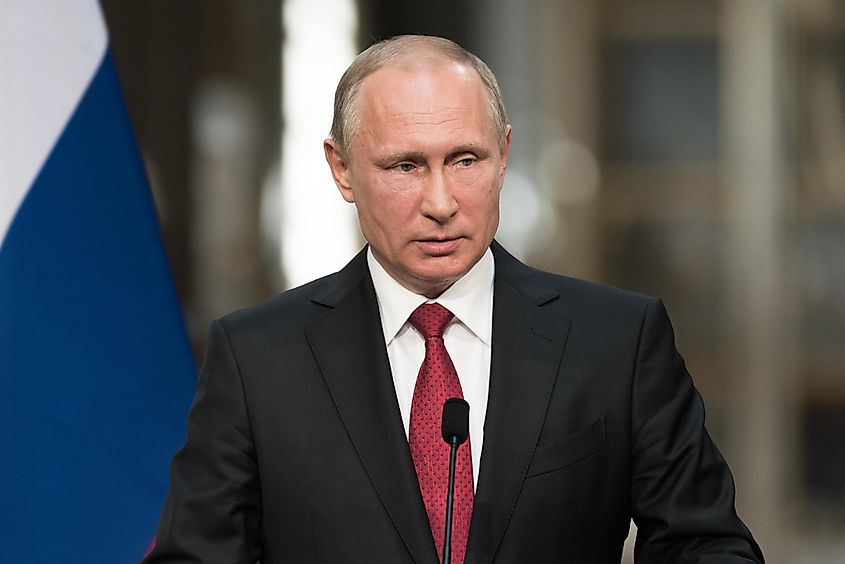
On New year's day's Eve in 1999, Russian President Boris Yeltsin, who led the country since the plummet of the Soviet Wedlock in 1991, resigned his position and turned power over to his prime minister, Vladimir Putin, who would afterwards win the presidential elections of that twelvemonth. Putin gained popular support for his actions in Chechnya later on he became prime number minister in the summer of 1999. Shortly after becoming president, he worked successfully to stabilize Russia'due south economy, earning him even more popular support. This popular support paved the fashion for his ability to make gradual changes to the operations of the Russian government over the years that followed.
Putin Consolidates Power
Arguably the showtime step Putin took to consolidate his power came in 2001, when the Russian government took over ORT and NTV, ii of the nigh popular independent media outlets in the land. This was the beginning of Putin'due south crackdown on the media in full general. Over the next few years, he would piece of work to overhaul Russian federation'due south political institutions to centralize ability under him. He also established his own political party, the United Russian federation political party, which would go on to boss the legislative branch of Russian federation's regime.
In 2008, Putin had to resign the Russian Presidency as he was simply allowed to serve two consecutive terms in line with the land'due south constitution. Thus, he became prime government minister once more until 2012, when he was allowed to run for the Presidency again. Between 2008 and 2012, information technology was by and large assumed that even though another person was serving as the president, the real ability remained with Putin. In 2012, Putin again won the presidential election. He then had the constitution amended to add an extra two years to his four-year term, and then that he could remain president until 2018 when he was then elected to a second term. Thus, he tin can remain in power until 2024. Some, however, believe that he will seek to amend the constitution so that he can rule beyond the stop of his second sequent term.
Putin's Russia
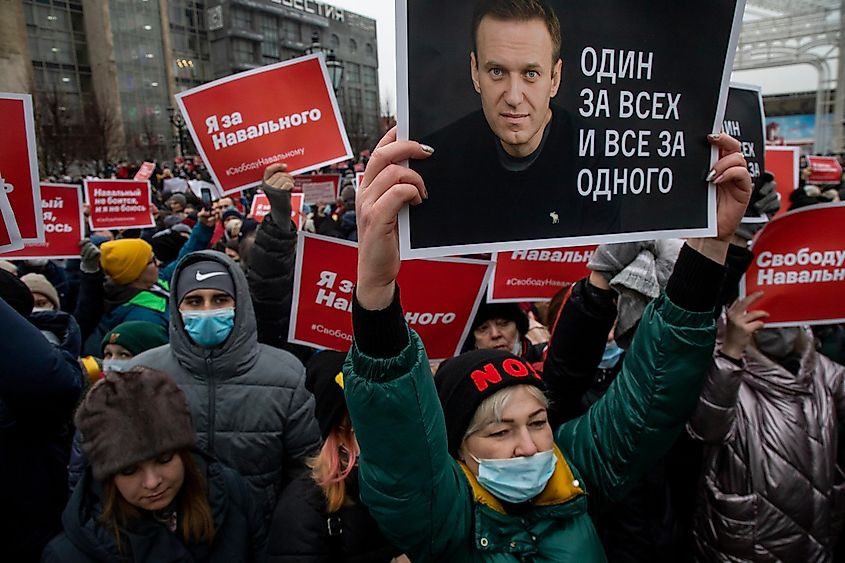
Opposition to Putin's rule has not ceased, but opposing the Russian President can lead to dire, if non fatal, consequences. Putin has been defendant of assassinating some of his critics on both Russian and foreign soil. Protests in Russia are violently suppressed, and opponents of Putin are routinely arrested and jailed. Some are given lengthy prison sentences.
In the most recent case, Alexei Navalny, who is considered by many to be the almost prominent opposition leader in Russia, was given a three and a one-half-year prison sentence for violating the terms of his probation. His probation is related to some other judgement handed down to him for abuse charges viewed past many as political and baseless. Moreover, Navalny violated his probation when he sought medical treatment away after being poisoned by a nerve agent. Many suspect that Putin was behind the poisoning, which almost led to Navalny's death. On the night Navalny was jailed, more than than one,000 of his supporters were too arrested.
Putin at present dominates all aspects of Russia's politics. Russia'southward media is all merely entirely controlled by Putin and his supporters. Putin has even built a kind of personality cult around himself, in the same way as other dictators throughout history have done. The wheels of democracy, in theory, are withal turning in Russian federation. Elections are still held, merely they are widely regarded as shams, particularly since Putin and his allies always change the country's election laws in their favor. In fact, even the poll workers themselves must be members of Putin'south United Russia party. Votes are counted backside airtight doors, and the results are routinely suspected of beingness rigged. Many would debate that Russia is fast becoming a totalitarian dictatorship.
Source: https://www.worldatlas.com/articles/what-type-of-government-does-russia-have.html
Posted by: twymanthimpard.blogspot.com
0 Response to "What Is The Makeup Of Russias Government"
Post a Comment