

How To Draw A Moon With A Night Cap And Stars
How To Paint The Moon
Acquire to create a painting of a full moon with acrylics on sail. This tutorial will guide you lot through the steps with picture instructions and video.
Painting a moon tin can be kind of intimidating. If you lot observe photographs of moons, you lot will notice in that location are various nighttime and light blotches.

If you lot look at super close up images of the moon, yous can also observe craters, little dots and some lines.
That leads the the difficulty of painting a moon. The dark blotches we observe really aren't a recognizable shape similar a middle or a square. They are organic. And tricky.
The best advice I can requite if you are trying to pigment a somewhat realistic representation of a moon is to await at a photograph. Really find where those dark areas are.

When I paint the moon, I look more at the photo than my painting. It'due south a technique that forces you to pigment what you run into rather than pigment what you call up you see.
Tip: Look more at your photograph when painting the moon. It forces y'all to paint what you see versus what you think y'all encounter.
Since this is an online tutorial, I will guide y'all through the steps of how I did this moon. I'll show you where I did my night blotches. It's not intended to be realism then don't worry about beingness perfect!

You can also use the techniques of this moon painting in other painting projects you lot may have. Perhaps you desire to do a full moon in a mural or over a body of h2o.
I did a night heaven since the moon is the focus of this painting. I likewise dry brushed a few clouds around the moon. Y'all can get out the moon in a clear sky if you'd like! I know clouds can be kind of intimidating.

Enjoy and happy painting!
Materials:
Active Time 1 hr 30 minutes
Full Time ane hour thirty minutes
Difficulty Medium
Materials
- Acrylic Paint
- 11 x 14 Canvas
- Paint Brushes
- Circle To Trace The Moon (7-9 inches)
- Optional White Paint Pen
Colors
- Titanium White
- Payne'southward Greyness
- Mars Black
- Phthalo Blue
Brushes
- 1/2" Filbert (Encounter notes)
- 3/4" Flat Wash
- 4 Round
Instructions
- Employ a pencil to trace a large circle (seven-9") on your canvass.
- Use a 3/4 Launder castor to paint a white ring around the moon.
- Lightly blend phthalo bluish with the white to create a lite blue tone effectually the moon.
- Gradually alloy more phthalo blue in the sky equally you piece of work your way to the edges of the canvas.
- Alloy Payne'south Grey on the furthest edges and corners of the canvas.
- Go dorsum and alloy the colors further if needed.
- Splatter stars on the canvass by tapping a paint brush of titanium white against another paint castor.
- Paint the circumvolve of the moon solid white. Proceed that white pigment wet because the moon texture will be washed with wet on wet blending.
- Employ a 1/2" filtert brush to blend Payne'southward grey in with the white. Observe how certain areas of the moon have darker markers.
- Add together more white to your filbert castor and blend in areas that are lighter.
- Load some mars black onto your palette and mix white with it to make a warm blackness. Blend in this black in diverse dark areas of the moon.
- Use a round brush to paint small-scale dots and 2 large craters on the moon.
- Paint the outer rim of the moon white using the round brush.
- Use the 1/two" filbert brush to dry out brush some clouds in the sky using titanium white, Payne's gray & phthalo blue.
- Splatter more stars in the heaven if necessary.
- Impact up the circle by laying the circle y'all traced over the moon and making sure your circle is uniform.
Notes
The brush I used for this moon, I phone call information technology a filbert simply information technology'southward really an oval wash brush. Click the link above to encounter exactly what castor I used. It's a ane/ii" oval wash brush.
Colour Palette:

Directions At A Glance:

Traceable:
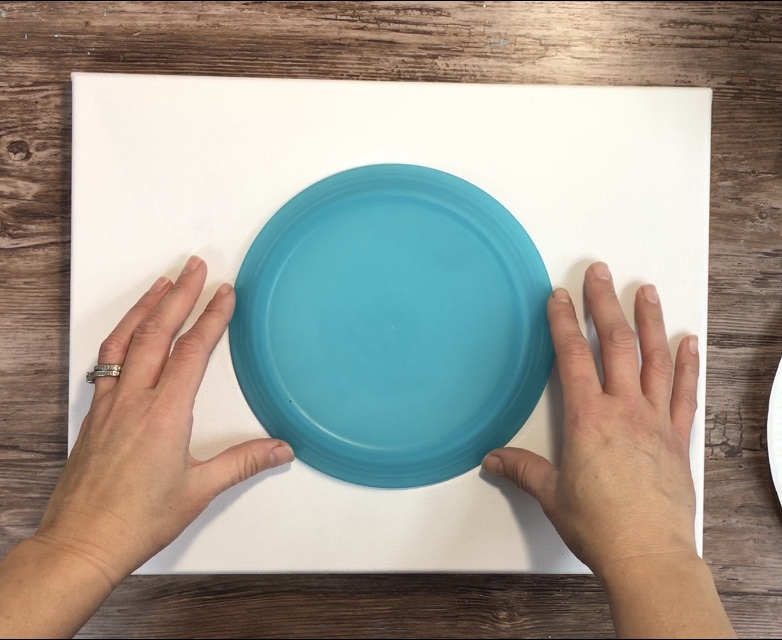
There is no traceable for this one! I traced a plastic plate with a diameter of seven.25". You can find one that has a 7-9 inch diameter.
Video:
Step By Footstep Instructions:
1. Trace a Circle
Position your canvas horizontally (or vertically if you prefer) and trace your circle with a pencil.

2. Paint The Heaven
Use a iii/4" Flat Wash brush to paint a titanium white ring around the moon. 
The width of the band should be the width of the brush (so 3/4").
Then load a tiny information technology of phthalo blueish onto the corner of your iii/4" wash castor. 
Using the wet on wet blending technique, alloy the phthalo blue into the white so that it turns to a lighter blue.

The intent with this technique is to allow a lighter blue to be closest to the circle and for the blueish to become darker as it gets to the border.

Continue adding more phthalo bluish to your castor and paint in circles working your manner to the edges of the canvas.

If y'all need to, add together more titanium white to help with the blending transition of the light blue to the pure phthalo blue. Annotation that I did non rinse by brush someday while painting this sky.
By the time you lot go to the edges, yous should take pure phthalo blue. (And any tiny bit of white is mixed into information technology considering you didn't rinse your castor).

And then load your brush in Payne'south grey (without rinsing information technology). If you need to, wipe your brush off because it may exist overloaded.

Pigment just the corner areas with Payne'due south gray and blend it in with the phthalo blue by painting over the phthalo blue surface area.

3. Splatter Those Stars
While I usually apply a toothbrush for this step (and you can besides), I decided to try a different mode this time to splatter my stars.
I loaded 1 of my brushes in white (my 1/2" filbert) and added a TINY flake of water to that white and then it was SLIGHTLY watered downwards.
Note: y'all don't want to water your white down besides much considering it volition drip everywhere and mess your painting up.
Exam out an area abroad from your canvas. Tap your loaded brush against another brush (like tapping drumsticks together) and allow the splatters get on the surface.

Then when y'all feel confident, do so over your painting. Don't worry about getting white splatters on the moon because that is all white correct now whatsoever way.
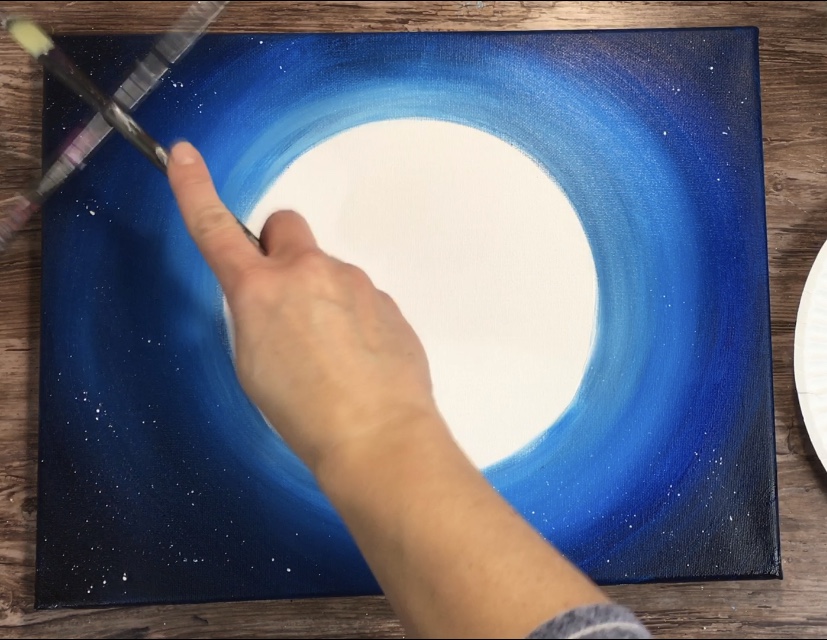
Try to aim for a variety of splatters big and pocket-sized. If you mess up, keep a baby wipe handy to sweep up and unwanted splatters.

four. Paint the moon white
This is an like shooting fish in a barrel just of import step. I do moisture on wet blending to paint my moons. In order to exercise so, you'll need your unabridged moon to be wet and white.
Simply use your 3/4" wash brush to paint a thick layer of white on that circle. By thick I don't mean slap on the pigment, rather apply a generous amount to it so information technology tin can easily exist composite and workable. .
five. Paint your first night blotches with Payne's Greyness & Titanium White
I used a ane/2" Filbert brush for this. I found that the round tip of the filbert immune for softer strokes that were piece of cake to blend.
On your palette, double load your filbert in Payne's grey and titanium white (about equal parts) to create a light cool gray.

Then paint your first set of dark blotches. I did my dark blotches in the upper left area of the moon…

And dabbled down to the middle left area. Do these strokes in little dabs. Your color should blend with the white on the moon likewise.

Then dab some more blotches in the upper center surface area and on the upper right. I loaded my filbert in a chip more than titanium white in this area to get some color variation in these grays.

And so continue your way down the moon adding more than blotches.

Load your castor in various amounts of titanium white and Payne's grayness to get color variation and retrieve to allow your strokes to blend with the white layer of the moon.
In some areas on the bottom of the moon I did super low-cal blotches.


Tip: remember to expect at a photograph of the moon and observe where you run across the dark blotches.
This is what my moon looked similar until I introduced a new shade of black.

vi. Pigment your second layer with Mars Blackness and Titanium White
Mars black is a warmer black color than Payne's greyness (which has blue undertones to it). Adding this new shade of greyness to the moon will give information technology some warmer tones.
Rinse off your 1/ii" filbert castor and dry it. And then double load mars blackness with titanium white (more titanium white than mars black because Mars black is a potent color).

Pigment more blotches in the areas that y'all painted the paynes greyness blotches (merely don't over do information technology).

Let these mars black/ titanium white blotches blend slightly in with the paynes gray ones.

If your mars black blotches are too nighttime, you can e'er go back and soften them with more titanium white.


7. Use a round castor to paint piffling craters, dots and lines
Employ a #4 round brush for this step and only titanium white. Paint little dots on the moon, specifically over some of the darker blotches.

Tp: while you tin can pigment little clusters of dots everywhere and make it await nice, its suggested to look at a existent epitome of the moon and come across where these little white dots (aka craters) bear witness up.

Also with my round castor, I painted these asterisk looking crater things. In the image to a higher place, my arrows point to them. There is one in the lower left and one at the top.
To paint these, I used titanium white with a lilliputian chip of Payne's grey so the lines show up agains the white.

So I slightly outlined the circle of the moon. Doing this ensures that the perimeter of the circle is nice and bright white.
8. Exercise some touch ups around the moon in the heaven
This is optional, only I felt the need to bear upon up the area around the moon. I used my three/4 flat to alloy in some more phthalo blue and white to make a brighter "moon ring" effectually the moon.


9. Do some dry brush clouds
I used my 1/2" filbert (aka oval wash) for the clouds and I did this dry brush style. This ways that I didn't load my brush in whatsoever water and only had a petty paint on the tip of the brush.
Also I use a paper towel to wipe my brush later on it's loaded to ensure the paint strokes are dainty and dry.

Load your filbert in the white, Payne's and phthalo simply specifically more white so information technology comes off as a medium gray-blue color.

When you exercise the clouds, work your brush in circular strokes forming the shape of the cloud. Because the brush is dry, you lot should all the same see the colour of the sky below it.


To create a lilliputian depth in the clouds, add some more titanium white to your castor and add together a few layers on the top tips of the clouds.
Yous tin can likewise overlap you clouds over the moon a bit.

Try to keep information technology unproblematic! I might have gone too far with the clouds but couldn't stop myself :-p
10. Some Terminal Touches
Go in and tap some more stars! This added a fun dimension to the sky with some stars showing through the clouds and gave information technology sort of a galaxy wait.
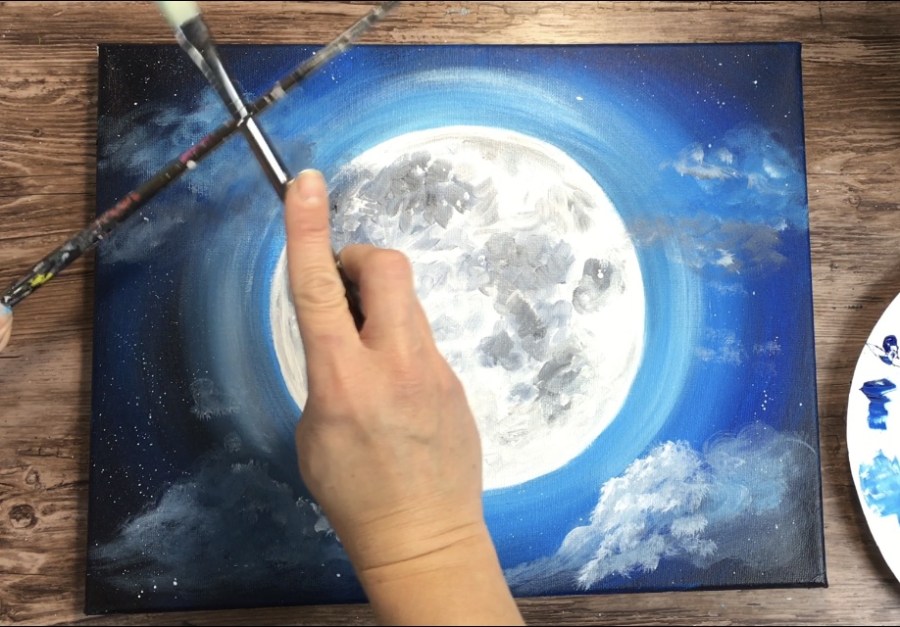
I suppose I could have done this three steps ago but I decided to make sure my circle was a perfect circle! I took my plate and so redid the calorie-free blue color effectually the moon so my circumvolve turned out nice and round.

Paint the sides if you have not done so all the same! I did my sides with paynes grey.

Employ a POSCA white pigment pen for some larger stars. Simply paint some clusters of smaller circles. You tin fifty-fifty brand some of them blurry by pressing your finger on the dots and smearing them a bit.


Finished!
This was a fun claiming! I dear painting the moon and if you're one of my active followers you may detect I do the moon A LOT. Cheers for viewing this lesson, I tin't wait to see how your moon turned out!

Share your art hither!



How To Draw A Moon With A Night Cap And Stars,
Source: https://stepbysteppainting.net/2020/01/21/moon-painting/
Posted by: twymanthimpard.blogspot.com
0 Response to "How To Draw A Moon With A Night Cap And Stars"
Post a Comment